At some point many clients decide to stop coloring: to go gray, to return to their natural shade, or simply to reclaim the time and appointments. Then they discover the hard part is not the decision. It is the year of hair that follows, where a hard line of regrowth divides two different colors and every photograph announces the transition. Most people quit halfway through that year, not because they changed their minds, but because nobody told them the in-between could be managed.
Growing out color gracefully is an active service plan, not a waiting period. This guide lays out the stages a Mooresville stylist works through: softening the line, blending the tones, and trimming on a schedule, so the grow-out reads as a gradual style change instead of an overdue appointment.
Why the line is the whole problem
Solid color creates a continuous sheet of pigment, and new growth interrupts it with a sharp boundary. The eye goes straight to that line, and high-contrast combinations, dark dye over gray, light dye over dark roots, make it shout. Everything in a graceful grow-out is aimed at that boundary: breaking it up, lowering its contrast, and moving the eye past it.
Length is the other factor. Hair grows about half an inch a month, so clearing the head of old color on long hair is a two-year project, while a shorter cut can complete the same transition in a season. Clients serious about the transition often take some length off early, not from impatience, but because the math of growth makes every inch surrendered worth two months of timeline.
Stage one: break up the boundary
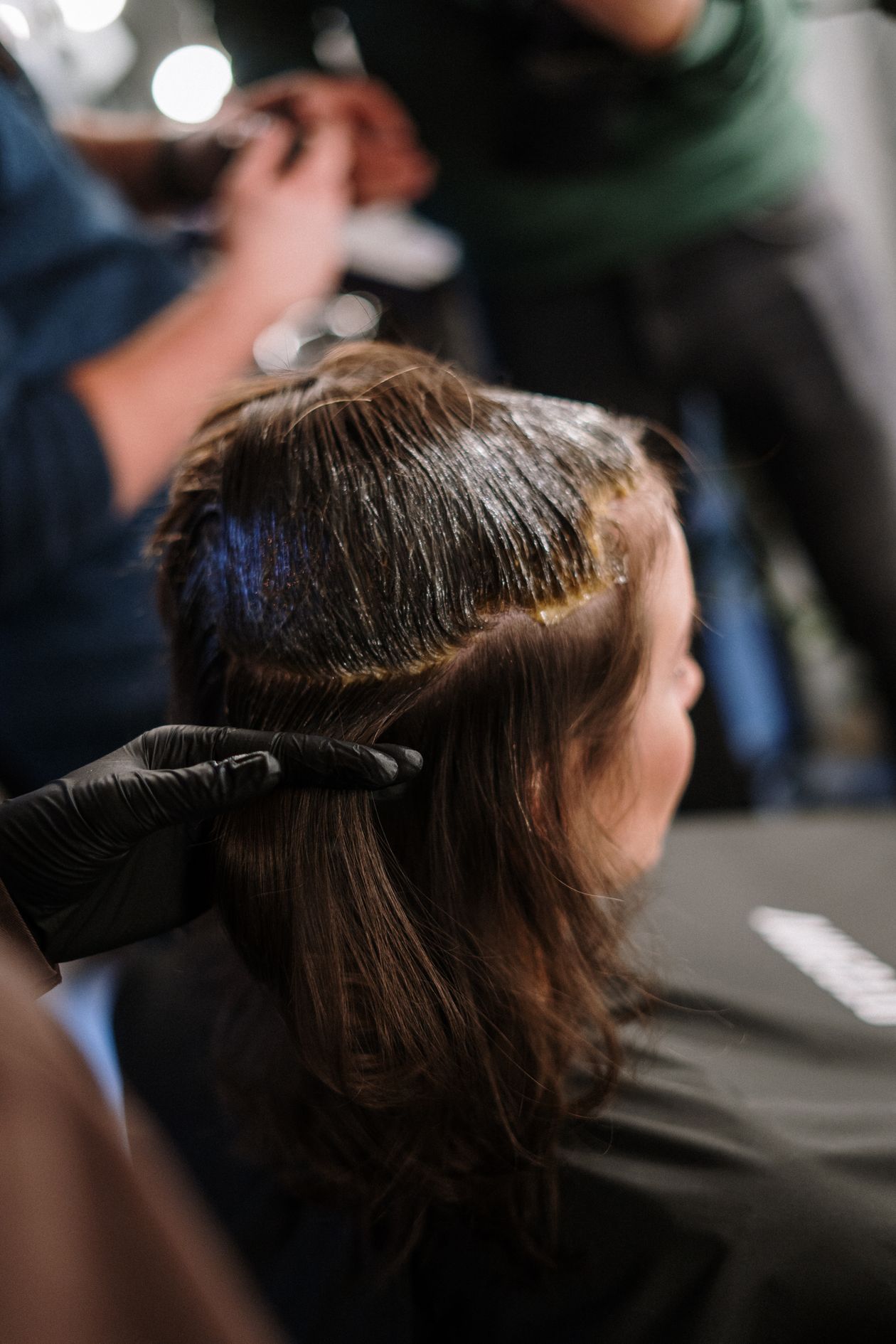
The first appointments replace the line with a blend. Stylists weave fine highlights or lowlights through the regrowth zone, in tones that bridge the natural color and the dyed length, so the sharp edge dissolves into a gradient. Gray-blending has become a specialty of its own, using the client's own gray pattern as the light pieces and adding dimension around them, rather than covering every strand.
This stage usually takes a couple of appointments spaced six to ten weeks apart. Each visit extends the blended zone further down the hair and lowers the contrast a step. The result from across the room is simply dimensional hair. Nobody at a distance can date your last full color, which is precisely the point.
Stage two: adjust the lengths
While the roots blend, the old color on the lengths needs management of its own. Dyed hair fades as it ages, often warmer and lighter than it started, and that drift can clash with a cool natural regrowth. Toners and glazes correct the lengths toward a tone that sits comfortably beside your natural shade. This is a short, inexpensive appointment relative to full color, and it does heavy work in a transition.
Condition is managed here too. The oldest hair, the ends, has been colored the most times and is the driest and most fragile part of the head. Conditioning treatments and honest trims keep the transition hair healthy enough to look like a choice. Hair that is breaking and frizzy reads as neglected whatever its color story is.
- Assess the contrast. The stylist maps your natural shade against the dyed length and sets the blend plan.
- Break the line. Fine highlights or lowlights through the regrowth turn a hard edge into a gradient.
- Tone the lengths. Glazes pull faded old color toward a tone that sits well beside your natural shade.
- Trim on schedule. Cuts every eight to ten weeks remove old color from the ends as the blend descends.
- Finish the transition. When blend and trims meet, the old color is gone and appointments become optional again.
The trim schedule that finishes the job
Every trim during a grow-out is progress measured in inches. A cut every eight to ten weeks that takes off slightly more than preference would, steadily removes the old color from the bottom while the blend descends from the top. The two fronts meet, usually somewhere around the one-year mark for medium-length hair, and the transition is simply over.
Clients who skip trims to preserve length often keep the last band of old color for many extra months, hanging at the ends like a reminder. A stylist can show you on your own hair exactly where the old color ends and what each trim buys. Seeing the finish line on a real head of hair makes the schedule easy to keep.
Living in the middle without hating it
The middle months need styles that work with a blend rather than against it. Waves and curls disguise transitions better than pin-straight styling, because texture breaks up tone boundaries. Parting in slightly different places, and styles with movement at the crown, all reduce the visibility of the blend zone on days when it bothers you.
And give the process its honest timeline when people ask, or do not discuss it at all. A grow-out done with a plan looks intentional at every stage, and most clients find the middle far less conspicuous than they feared. The mirror at home, at close range, under bathroom light, is the harshest judge your hair will ever face. Everyone else sees the blended version.
Common questions
How long does growing out color take?
Hair grows about half an inch a month. Short hair can transition in a season, shoulder-length hair in about a year with blending and regular trims, and long hair longer.
What is gray blending?
A technique that weaves highlights and lowlights through regrowth to soften the line between dyed hair and natural gray, so the gray grows in as part of a dimensional pattern.
Do I have to cut my hair short to grow out color?
No, but every cut shortens the timeline by removing old color from the ends. Regular trims that take a little extra are the middle path most clients choose.
Photos in this guide are representative stock images.
← All guides from Salon Zele← Back to Salon Zele